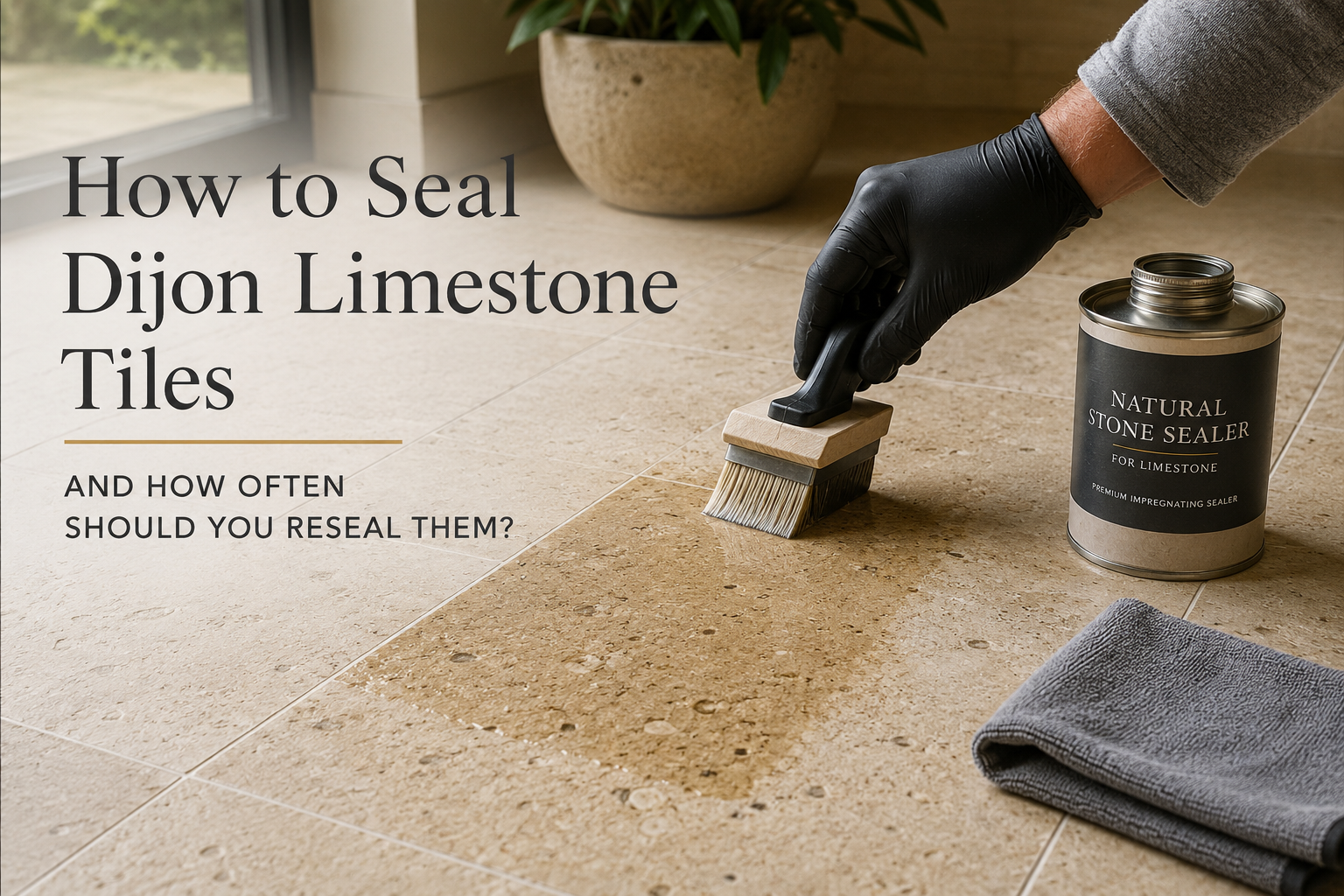
How to Seal Dijon Limestone Tiles and How Often Should You Reseal Them?
Dijon limestone has a warmth and natural variation that is difficult to recreate with a manufactured tile. Its soft beige tones, subtle fossil detail and gentle variation give a floor a more lived-in character, but as a natural stone, it does need the right protection to keep that appearance looking its best.
If you have recently installed, or are considering installing, Dijon limestone tiles, sealing is one of the most important parts of the care routine. Limestone is naturally porous, so liquids can penetrate the stone if it is left unprotected. A suitable impregnating sealer helps reduce that absorption and makes everyday spills and cleaning much easier to manage.
The important point is that sealing is not a one-time job. The protection gradually wears out with foot traffic, moisture and cleaning, so knowing when to reseal Dijon limestone is just as useful as knowing how to seal it in the first place.
Why Does Dijon Limestone Need to Be Sealed?
Limestone is a natural, calcium-carbonate-based stone with a porous structure. The degree of absorption varies between stones and finishes, but unlike porcelain, it is not an almost completely non-absorbent surface.
In practical terms, this matters when something is spilled on the floor.
A glass of wine knocked over in the dining room, cooking oil dropped in the kitchen or muddy water brought in through the hallway can potentially find its way into the stone. Once absorbed, some stains can be considerably harder to remove than they would be from a dense porcelain tile.
Sealing does not make Dijon limestone completely stain-proof. Instead, a good penetrating sealer reduces how readily water and oil-based contaminants enter the stone, giving you more time to wipe up spills and making routine maintenance more manageable.
It is also worth remembering that sealing and acid protection are not the same thing. Limestone remains sensitive to acidic substances, so products such as vinegar, lemon juice and acidic limescale removers should still be avoided. Sealing can improve resistance to staining, but it cannot prevent acid from reacting with the calcium carbonate in the stone.
What Type of Sealer Should You Use on Dijon Limestone?
For Dijon limestone, a penetrating or impregnating sealer is generally the type to look for.
Unlike a topical coating that sits on top of the tile and can alter its appearance, an impregnating sealer penetrates into the stone's pores. This is particularly useful when you have chosen Dijon limestone because you want to retain its natural, understated appearance.
Always check that the product is suitable for limestone and follow the manufacturer's instructions. Different sealers have different coverage rates, drying times and application requirements, so there isn't one application method that should be assumed to work for every product.
This is also a good reason to test the sealer on an inconspicuous tile or spare piece of stone first. Natural limestone can vary in colour and absorption, and testing gives you an opportunity to see how the finished surface will look before treating the whole floor.
What Should You Do Before Sealing Dijon Limestone?
Good sealing starts before the bottle of sealer is opened.
Make Sure the Tiles Are Clean
The surface needs to be free from dust, dirt, adhesive residue and other contaminants. If anything is trapped beneath the sealer, you may effectively be sealing that residue into the surface.
For routine cleaning, use a cleaner that is specifically suitable for natural stone and avoid acidic products.
Make Sure the Limestone Is Completely Dry
This is particularly important with newly installed flooring.
A surface can look dry while moisture remains within the stone or beneath it. Adhesive and bedding materials may also need considerably longer to release moisture than the apparent surface drying time suggests.
Your installer should be able to advise on the appropriate drying period for the particular installation.
Rushing this stage can undermine an otherwise careful sealing job, so patience here is worthwhile.
Test the Sealer First
Apply a small amount of the chosen product to an inconspicuous area and allow it to develop according to the manufacturer's instructions.
Check the colour, finish and overall appearance before proceeding with the rest of the floor.
This is especially useful with Dijon limestone because one of its attractions is its natural variation. You want the protection to preserve that character, rather than unexpectedly changing the appearance of the stone.
How to Seal Dijon Limestone Tiles
Once the limestone is clean, completely dry and ready for treatment, the application itself is relatively straightforward.
1. Prepare the Room
Make sure there is adequate ventilation and that the floor is clear of furniture, dust and other obstacles.
Read the sealer manufacturer's instructions before starting. Pay attention to coverage, application method, drying times and whether the product requires one or more coats.
2. Apply the First Coat
Work in manageable sections rather than trying to cover the entire floor at once.
Apply the sealer evenly with the recommended applicator, making sure the limestone receives consistent coverage. Avoid allowing excessive amounts of product to collect in one area.
Working methodically is particularly helpful on larger kitchen or hallway floors because it makes it easier to keep track of where the sealer has already been applied.
3. Remove Excess Product
This is an important part of the process.
Don't assume that more sealer left sitting on the surface means better protection. Any excess should be removed according to the product instructions, rather than being allowed to dry into visible patches or pools.
The finished floor should look evenly treated rather than covered in a noticeable surface film.
4. Allow It to Cure
Give the first coat the full drying or curing time specified by the manufacturer.
Avoid heavy traffic and don't start cleaning the floor normally until the product has had sufficient time to cure.
The temptation to walk on a newly sealed floor because it looks dry is understandable, but appearance isn't necessarily an indication that the treatment has fully cured.
5. Apply Additional Coats If Required
Some impregnating sealers require more than one application, while others are designed as a single-coat treatment.
Follow the instructions for the particular product rather than assuming that two coats are always better.
If grouting is part of a new installation, the timing of sealing and grouting also needs to follow the guidance provided by your tile, adhesive, grout and sealer manufacturers.
When Should Dijon Limestone Be Resealed?
There isn't one universal resealing schedule that suits every Dijon limestone floor.
The right interval depends on several factors:
- How much foot traffic the floor receives
- Whether it is in a kitchen, hallway or living area
- How much moisture the stone encounters
- How frequently the floor is cleaned
- The type of sealer originally used
- The particular limestone finish and its absorption characteristics
As a general guide, many indoor Dijon limestone floors may need resealing around every 3–5 years, while bathrooms and other consistently damp areas may require attention considerably sooner. One Dijon limestone specialist recommends 3–5 years for typical indoor areas and around 6–12 months for bathrooms and shower areas.
These should be treated as useful starting points rather than fixed deadlines. The manufacturer's instructions for your specific sealer should take priority.
A Busy Kitchen May Need Attention Earlier
Consider a family kitchen with several people walking through it every day.
There is likely to be more grit underfoot, more frequent cleaning and a greater chance of food and liquid spills than in a lightly used sitting room. In that environment, the sealer can be challenged more frequently.
This is why looking at the condition of the protection itself is often more useful than simply putting a date in your calendar.
How Can You Tell If Dijon Limestone Needs Resealing?
One simple check is the water-drop test.
Place a few drops of clean water on an inconspicuous section of the limestone and observe what happens.
If the water continues to sit on the surface and forms visible beads, the existing protection may still be working.
If the water quickly darkens the stone and begins absorbing into it, the sealer may have become less effective and the floor could be ready for resealing.
This is a useful practical indication, but it isn't a substitute for the sealer manufacturer's maintenance instructions. The finish, porosity and condition of the particular stone can all influence the result.
Does Cleaning Affect How Often You Need to Reseal?
It can.
Regular cleaning is essential for keeping limestone looking good, but using unsuitable products can gradually damage the stone or affect its protective treatment.
A good everyday routine is relatively simple: remove loose grit regularly, clean spills promptly and use a pH-neutral cleaner formulated for natural stone.
For a more detailed look at everyday cleaning, stain removal and long-term care, you can also read our guide to cleaning and maintaining Dijon limestone.
Avoid relying on household cleaning "hacks" simply because they are natural. Vinegar and lemon juice, for example, are acidic and can etch limestone. The Natural Stone Institute also advises using mild, non-acidic cleaning products on calcareous stones.
What Happens If You Don't Reseal Dijon Limestone?
Over time, the protective effect of a sealer naturally diminishes.
Once the stone becomes more exposed, liquids can be absorbed more readily. That doesn't mean an unsealed floor will suddenly become unusable, but stains can become more difficult to deal with and the stone can require more intensive maintenance.
Resealing is therefore less about making Dijon limestone "maintenance-free" and more about making the maintenance you already need to do easier.
That distinction is worth understanding when choosing natural stone. Limestone has genuine character precisely because it is a natural material, and a sensible care routine helps you enjoy that character without expecting the stone to behave like porcelain.
Final Thoughts
Sealing Dijon limestone is a relatively simple job, but getting the preparation right makes a significant difference. Clean and completely dry tiles, a suitable penetrating sealer, careful application and proper curing time all help the treatment perform as intended.
When it comes to resealing, don't rely solely on a fixed number of years. A busy kitchen, hallway or bathroom will place different demands on the stone than a lightly used room, so monitor the performance of the sealer as part of your normal cleaning routine.
With the right care, Dijon limestone can remain a practical floor covering as well as a beautiful one. At Royale Stones, we believe choosing natural stone should come with understanding how it will perform in everyday life, not just how it looks when it is first installed. You can explore our wider collection and natural stone options on Royale Stones.
0 Comments Add a Comment?